I spent half my pregnancy in pain because I thought that was just how it was
On finally understanding what pregnancy support actually means – and why I wish I figured it out sooner.
I'll never forget the moment I realised I needed help. It was week 20, I was standing in the kitchen making dinner, and my pelvis sent up a flare of pain so sharp I had to bite my tongue. My husband asked if I was okay, and I lied through gritted teeth: I'm fine. But I wasn't fine. I hadn't been fine for weeks, actually. I'd just been telling myself that discomfort was part of the deal. That you signed up for this when you got pregnant, and you got on with it.
Nobody had told me otherwise. My midwife was lovely and thorough, but the conversation about support – real, structural, biomechanical support – never happened. I left every appointment with a leaflet about folic acid and a vague sense that if something was really wrong, I'd know. And so I kept going, kept pushing through, kept telling myself it would ease off.
It didn't ease off.
The trimester nobody warns you about properly
The first trimester is its own kind of survival mode. I was exhausted and nauseous and couldn't tell anyone why I kept leaving meetings early. But structurally, my body was still mine. I could move around normally, sleep in any position I liked, get in and out of the car without thinking about it. I had no idea how much I'd miss that.
Around week 20, something shifted. I had a visible bump, and suddenly the simplest things started costing me something. Standing at the kitchen counter for twenty minutes. Walking the dogs. Sitting at my desk for a full working day. By the evening I was stiff in a way I'd never been before, and I was waking up at 3am having to completely reorganise myself in bed just to get comfortable. My lower back ached constantly. I started googling things like pregnancy belt and back pain second trimester and feeling quietly embarrassed about it, like I was already failing at the physical part.
I borrowed a belly band from a friend. It was fine for about forty minutes and then it rolled up under my bump and spent the rest of the day doing nothing useful. I bought a slightly better one. Same problem, better fabric. What I didn't understand yet – what nobody had explained – was that a stretchy band around your middle isn't actually support. It's just fabric. Real support has to account for how your weight is redistributing, how your pelvis is shifting forward, how your whole centre of gravity is changing week by week. I didn't know any of this because I'd never needed to.

By week 32, I was winging it
The third trimester arrived and took everything up several notches. Getting off the sofa required a plan. Rolling over in bed involved a manoeuvre I started thinking of as the three-point turn. Getting in and out of the car – specifically the part where you have to swing your legs – became something I actively dreaded. I was still eight weeks from my due date and I was already just counting down.
A friend mentioned Hugup. I looked it up, saw the price, briefly closed the tab. Then opened it again. Then closed it. Then had another bad night and ordered it the next morning.
I want to be honest here, because I think people sometimes write these things up like a conversion experience, all before-and-after drama. It wasn't like that. What it was, was immediate and noticeable and genuinely different from everything else I'd tried. The engineering is Italian, the fabric is 3D-knitted, it's designed with biomechanics experts – which sounds like marketing until you actually put it on and feel that the weight of your bump is being properly redistributed rather than just vaguely contained. My pelvis felt held in a way it hadn't in weeks. My lower back stopped aching within a couple of days of consistent wearing.
The adjustable fastening meant I could actually adapt it depending on what I was doing – tighter when I was walking, a bit looser when I was sitting at my desk for hours. It didn't roll. It didn't dig in. It didn't slip down every time I moved. These feel like low bars, but after months of products that failed all three tests, they genuinely weren't.

What I'd tell myself at week 12
You don't need structured support in the first trimester. You probably don't need much in the early second either. But you do need to stop thinking of pregnancy support as something you resort to when things get bad. By the time things get bad, you've already spent weeks in unnecessary discomfort. I kept waiting for a threshold – some level of pain that would feel officially bad enough to justify spending money on something that might actually help. That threshold kept moving.
Adjustability matters more than I thought it would, because your body changes week to week and what fits perfectly at 28 weeks might feel completely different at 34. Material quality matters too – not for vanity reasons but because you're wearing this thing all day and cheap synthetic fabric against a bump you're already running hot in is its own kind of misery. And it genuinely needs to do more than one job. In the third trimester I did not have the bandwidth for a different product for my back and a different one for my pelvis and something else for my bump. One thing that worked was what I needed.
Hugup was that thing for me, in the end. I wish I'd found it earlier – not because the first half of my pregnancy was a disaster, but because some of the discomfort I accepted as inevitable turned out to be entirely preventable. That's the part that still bothers me a little. Not that it was hard. That it was harder than it needed to be.
If you're currently sitting with an aching back, googling whether what you're feeling is normal – it might be. But normal doesn't mean you have to just absorb it. Listen to what your body is telling you. It's usually asking for something specific.

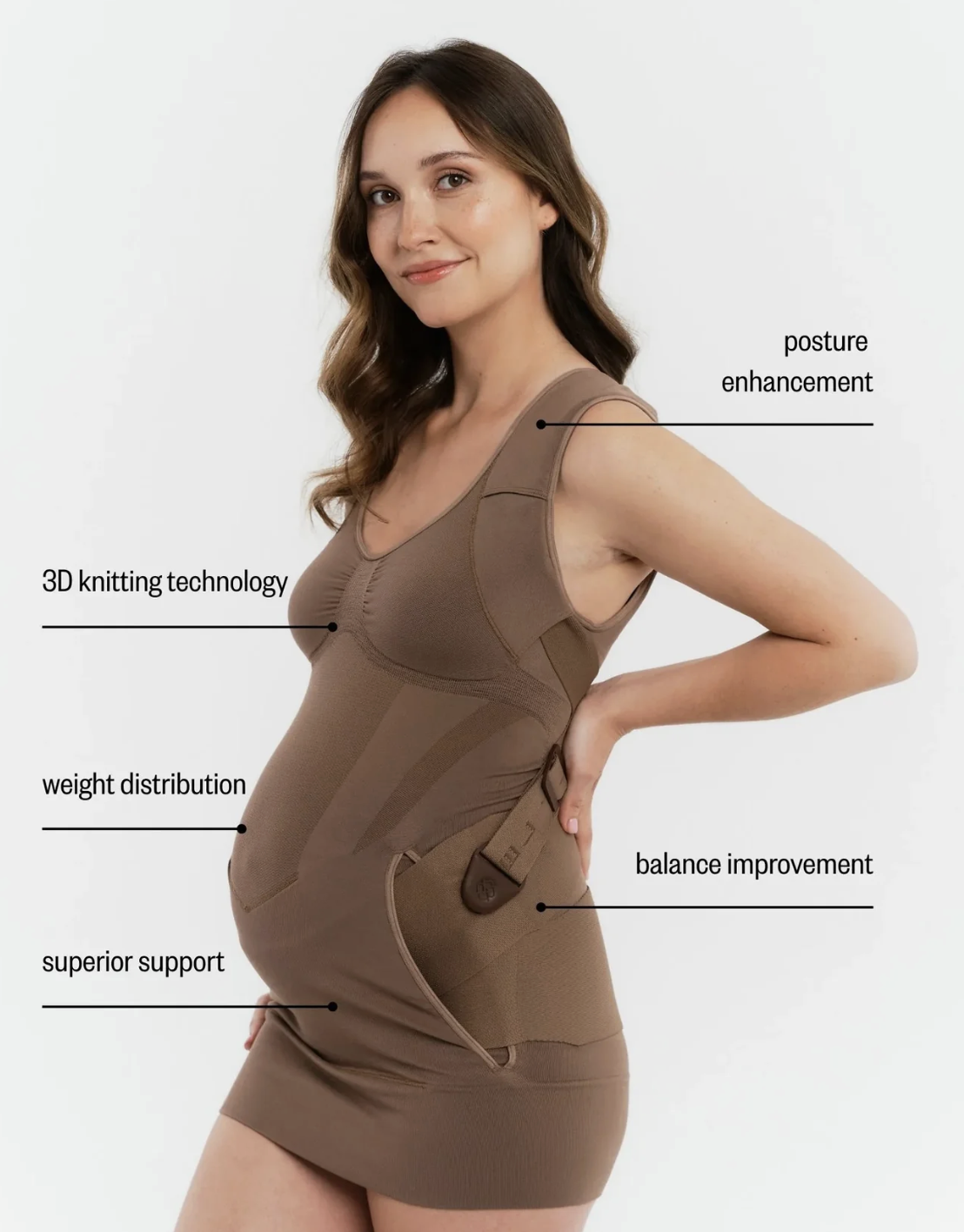
Looking for biomechanically-designed pregnancy support? Learn more about supportive maternity belts for third trimester that are clinically evaluated and built to last.